Midkhat Shagiakhmetov took part in a joint meeting of the State Duma Committee on Economic Policy and the Operational Headquarters for ensuring socio-economic stability in Tatarstan
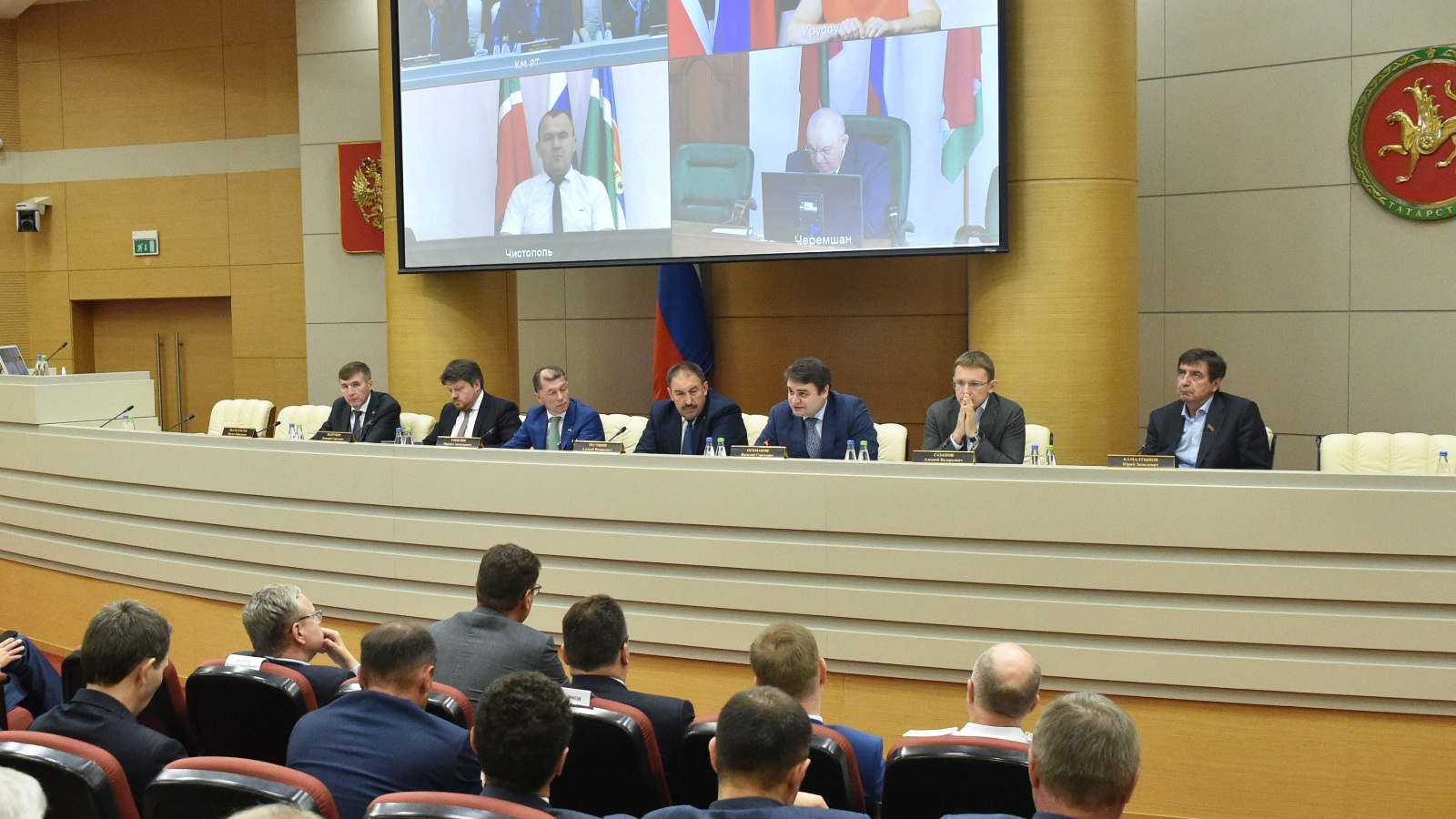
Deputy Prime Minister of the Republic of Tatarstan - Minister of Economy of the Republic of Tatarstan Midkhat Shagiakhmetov took part in a joint meeting of the State Duma Committee on Economic Policy and the Operational Headquarters for Ensuring Social and Economic Stability in the Republic of Tatarstan. The event was held at the House of the Government of the Republic of Tatarstan.
The meeting was also attended by Chairman of the State Duma Committee on Economic Policy Maxim Topilin, First Deputy Minister of Industry and Trade of the Russian Federation Vasily Osmakov, Deputy Minister of Economic Development of the Russian Federation Dmitry Vakhrukov, Secretary of State - Deputy Minister of Finance of the Russian Federation Alexei Sazanov, representatives of republican ministries and departments, business leaders.
Alexey Pesoshin noted that in connection with the unprecedented sanctions pressure on Russia in the republic, a plan was prepared in the shortest possible time to ensure the sustainable development of the economy and an Operational Headquarters was created. The priority tasks were to provide the population with essential goods, maintain employment and support programs for the population, the smooth functioning of backbone organizations through the creation of new logistics and production chains, as well as ensuring the operability of critical infrastructure and helping small businesses in the new conditions.
According to the Prime Minister of the Republic of Tatarstan, the current economic situation has had the greatest impact on the chemical industry, rubber and plastic products, and the production of vehicles. The total share of these areas is 28% of the industrial production of the republic. In addition, the turnover of retail trade has decreased. Its share in the economy of the republic is more than 4%. This is also due to a decrease in sales of non-food products.
“In the second half of the year, according to available forecasts, risks remain in the supply of imported components and raw materials, logistics, restrictions on exports and capacity utilization of enterprises of the republic, short supply of equipment that affect the implementation of investment projects. Such risks are indicated by almost half of the backbone organizations included in the federal list (26 out of 60). They form 30 percent of the republic's economy. They employ 105 thousand people. And this is without taking into account the impact on related industries,” said Alexey Pesoshin.
As a result of the imposed sanctions, difficulties remain in making payments with foreign counterparties. In addition, the ruble exchange rate affects the competitiveness of the products of our producers, both in foreign and domestic markets.
The Head of the Government of the Republic of Tatarstan noted that, in combination, these factors significantly affect economic entities. “The operational headquarters monitors the issues of releasing employees of enterprises on an ongoing basis. More than 15,000 people are in part-time mode, more than 3,000 are in idle mode,” he stressed.
Under these conditions, enterprises are working to establish new cooperative ties, including cooperation agreements with the largest Russian corporations: Gazprom, Lukoil, Rosatom and Transneft. They are rebuilding supply chains in cooperation with companies from other regions of Russia, and are also looking for new sales markets, including with the participation of partners from friendly countries.
Alexey Pesoshin noted that in terms of import substitution, work is being carried out with scientific and educational institutions and engineering companies. On the issues of import substitution of materials and components in the interests of republican manufacturers, a working group was created, which included representatives of SIBUR Holding, KAMAZ, Tatneft, and a number of other enterprises and universities.
At the same time, for the smooth operation of enterprises in the short and medium term, additional decisions are needed at the federal level, the Prime Minister of Tatarstan said. Corresponding proposals have been prepared with the enterprises of the republic.
Maxim Topilin, in turn, noted that the changes taking place in the world today are of a fundamental nature. And therefore there will be no return to the previous device. This primarily concerns the trade and economic activities of Russia. “You need to understand that it will definitely not be the same as before. The fact that we were fully export-oriented, worked with a huge number of European partners - this will not happen. You need to understand that everything has changed, ”the chairman of the State Duma Committee emphasized.
According to Maxim Topilin, today it is important to stimulate domestic demand and develop the scientific base. “We need guarantees of domestic demand. This requires amendments to the competition law, corporate purchases. “We need to build this technology,” he said. - The topic of R&D, investments in scientific developments is also important. We are ready to consider proposals on how to stimulate them, how to withdraw them from taxation or somehow compensate for these costs.”
Dmitry Vakhrukov noted that under the sanctions, new niches are opening up for domestic producers. “There are import restrictions, including logistical ones. A number of companies are leaving. The demand for products is growing. These are the opportunities for supplying the domestic market that are emerging and which must be taken advantage of. This is the general goal - to maintain the maximum amount of added value in Russia within the framework of the full production chain,” said the Deputy Minister of Economic Development of the Russian Federation.
He also noted that today a number of proposals are being developed to improve the activities of special economic zones. In particular, it is planned to work out a model for the development of stable cooperation chains through the SEZ.